Bulgaria's Black Sea coast is one of European golf travel's least-discussed propositions — a region where clifftop fairways, sea-view resort golf, spa recovery, and shoulder-season value converge in ways that more obvious destinations simply can't match on price or space.
Bulgaria recorded roughly 13.25 million foreign visitor arrivals in 2024, a five-percent jump over the previous year. Almost none of those visitors came for golf. This gap between a growing tourism market and an almost invisible golf-travel profile makes the Black Sea coast worth a closer look right now, especially for the character of its courses.
Why the Black Sea Coast, and Why This Year
The global golf tourism market reached an estimated US$10.6 billion in 2024, with demand shifting beyond fairways to culture, gastronomy, wellness, and what some analysts call "experience-led itineraries." Younger travellers, often booking as families or multi-generational groups, increasingly prefer villas and larger suites over golfer-focused stays. Bulgaria's Black Sea corridor around Balchik and Varna fits that template better than its reputation suggests.
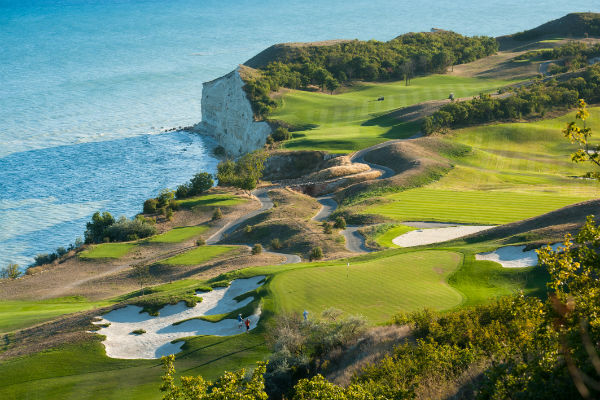
The golf courses here are defined less by parkland polish and more by exposure, elevation, and scenery. Several layouts sit on high ground above the Black Sea, where holes move across open terrain and along cliff edges, with wide views and little shelter from the wind. The result is golf that feels spacious and dramatic rather than enclosed: long carries can look intimidating, approach shots are shaped by the breeze, and even shorter holes gain difficulty from the coastal setting.
Lighthouse Golf & Spa Resort, near Balchik, anchors the proposition. Its 18-hole course sits adjacent to the hotel and uses the natural plateau above the sea to strong effect, with broad fairways, rolling ground, and sea views from several holes. The course has a resort feel, but not a soft one: exposed stretches demand solid ball-striking when the wind rises, and the more open design places a premium on distance control rather than simply keeping the ball in play. A full spa sits on-site, and the beach is about six kilometres away. It's a stay-and-play setup that bundles golf, recovery, and coastal leisure without requiring a car for core activities. For travellers accustomed to the Algarve or Belek, the format will feel familiar. The price won't.
BlackSeaRama Golf & Villas, also near Balchik, is perhaps the most visually dramatic of the coastal options. Set high above the sea, it plays across open cliff-top terrain with expansive views and a more overtly strategic feel than many resort courses. The routing leans into the natural exposure of the site, so wind becomes part of the design rather than just a weather variable. Fairways are generous enough from the tee, but the challenge sharpens on approaches and around greens, where trajectory and distance control matter. The villa-led accommodation model suits groups and longer stays, and the overall atmosphere feels polished without losing the rawness of the setting.
Thracian Cliffs Golf & Beach Resort is the course most closely associated with the Black Sea coast's golfing image. Its holes are routed across a striking stretch of coastal terrain, with dramatic elevation changes and several sea-edge moments that make it one of the most photogenic golf settings in the region. This is not subtle golf: the visuals are bold, the carries can be intimidating, and the round often feels as much about managing nerves and wind as executing a game plan. For some travellers, it will be the headline reason to come. For others, especially those less comfortable with exposed, high-drama resort golf, it may be the most demanding test of the trip. Either way, it gives the coast a genuine signature course.
More broadly, Black Sea coast golf is shaped by firm turf, open horizons, and a style of play that rewards adaptability. These are not heavily tree-lined courses where every hole feels separate from the next. Instead, they tend to play across exposed ground, where wind direction can change club selection as much as yardage does. Golfers who enjoy visual drama, strategic approaches, and the occasional links-like influence in the short game will find plenty to like.
A "value plus premium" split is emerging across golf travel: travellers want better value while still paying for standout, high-quality experiences. Bulgaria sits squarely in that gap. Green fees run well below western European equivalents, and resort accommodation follows the same pattern. The savings are structural, driven by lower labour costs and a currency (the lev) pegged to the euro at a favourable rate.
Seasonality: The Constraint That Becomes an Advantage
Eurostat-based reporting indicates that 43 percent of all overnight stays in Bulgaria concentrate in July and August. Weekends along the coast often sell out, while weekday occupancy hovers around 50 to 60 percent. Early in the season, some coastal areas report arrivals down 30 to 40 percent from peak, improving only as July arrives.
For golfers, that's not a problem; it's the opening.
The best weather for coastal golf runs from mid-May through late June and again from early September into mid-October. Temperatures sit in the low-to-mid twenties, wind is manageable, and the courses are in strong condition after spring maintenance or before autumn dormancy. These shoulder months also happen to be when weekday occupancy is softest, meaning tee times are available, spa slots aren't contested, and resort pricing drops. A Tuesday-to-Friday arrival pattern in late May or mid-September captures the best of both conditions and cost.
These months also show the courses at their most enjoyable. In late spring, the fairways still carry some freshness and colour, while the rough is more playable and the sea air feels mild rather than oppressive. By September, the turf tends to firm up, bringing more bounce into the game and making the coastal contours more relevant. In both periods, the courses feel less like busy summer resorts and more like proper golf destinations.
Tourism expert Rumen Draganov has noted that Bulgarian tourism interest is shifting toward Sofia and Plovdiv rather than the traditional Black Sea summer model. For golf travellers, this shift means the coast isn't being overbuilt for mass tourism like parts of Turkey or southern Spain. The pace remains slower, and the density lower.
Planning the Week
A smart week on the Black Sea coast includes three to four rounds, with recovery days built around the spa and the region's surprisingly good local wine. That rhythm suits the courses well: they are scenic and engaging, but also exposed enough that playing repeatedly in strong afternoon wind can be more demanding than the scorecard suggests. Spacing rounds out lets you enjoy the golf rather than simply endure the elements.
The Thracian Plain wine region is within a half-day's drive, and several coastal restaurants serve Bulgarian varietals (Mavrud, Rubin) that most visitors won't have encountered. Pairing a golf trip with a wine afternoon or a visit to the botanical gardens in Balchik transforms a golf holiday into an experience-led itinerary.
Getting there is straightforward. Varna Airport handles direct flights from most major European hubs during the summer, with transfer times to the Balchik area running about 45 minutes. Off-peak, connections through Sofia add a leg but remain manageable. Car hire is inexpensive, and the roads north of Varna are decent, though not fast.
Who it's for: couples or small groups looking for resort-quality golf with spa recovery and coastal downtime, at a price point that allows for a longer stay or a second trip. Travellers who enjoy discovering a destination before the crowds find it, and who like courses with views, wind, and a little tactical variety. Who should skip it: anyone expecting a multi-course rotation with 36 holes a day. The region doesn't yet have the course density of the Algarve or Costa del Sol, and that's unlikely to change soon, even with new inland projects like OKOL Lake Park near Sofia signaling broader investment in Bulgarian golf infrastructure.
The Coastal Conditions Angle
Wind off the Black Sea is real. Afternoon breezes pick up reliably from late morning, and exposed holes near the cliffs play longer than their yardage suggests. Bring a wind layer and expect to flight the ball lower on approach shots. It's worth packing a utility iron or hybrid that travels well in luggage rather than relying on high-lofted fairway woods that the breeze will punish. The turf tends toward firm, especially in September, rewarding run-up shots and a links-adjacent short game.
That combination of wind, firmness, and elevation is what gives the Black Sea courses their identity. They are not true links, and they do not pretend to be. But they borrow some of the same golfing questions: can you control trajectory, use the ground, and stay patient when conditions turn a simple hole into a demanding one? Golfers who enjoy that kind of test will find the courses more memorable than their low profile suggests.
None of this is extreme, but it rewards preparation over improvisation, creating a trip that sticks with you longer than another calm-weather resort round in 28-degree heat.
Bulgaria's Black Sea coast won't appear on many golf-travel shortlists this year. That's part of the appeal and the opportunity. The courses are scenic, exposed, and more strategically interesting than many travellers expect; the infrastructure works, the value is genuine, and the shoulder-season conditions suit golfers better than the peak-summer crowds the coast was originally built for. The smart move is to go while the tee sheet is still open.