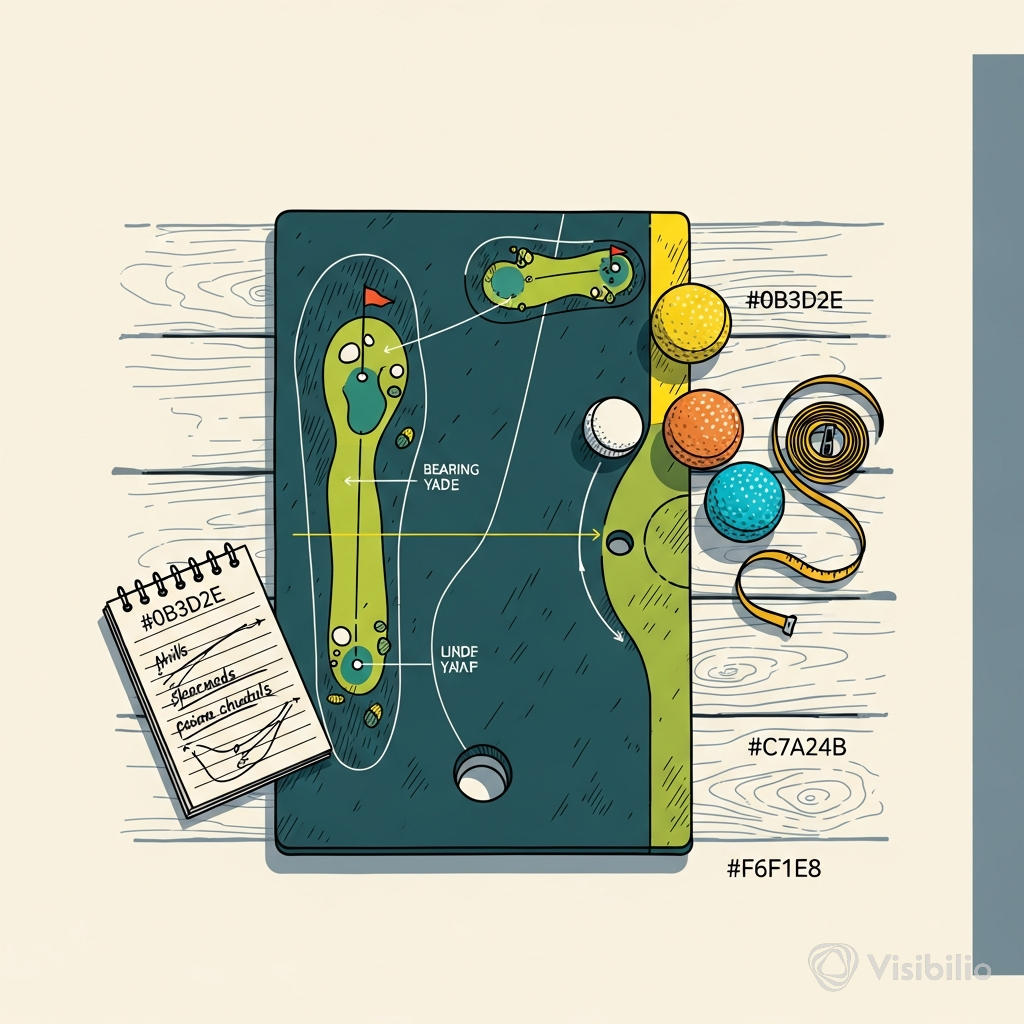
Putting accounts for roughly 40% of total strokes, and amateur golfers miss the green in regulation about 60% of the time — yet junior practice plans still treat the short game as an afterthought. Here's how to fix that, drill by drill, in 10–20 minutes a session.
Putting accounts for roughly 40% of total strokes in a round of golf, and amateur golfers miss the green in regulation about 60% of the time. This highlights a crucial point: the short game is where scores are made and lost. Yet, many junior practice plans still treat chipping, pitching, and putting as filler between range sessions. The solution isn't more practice; it's better-structured practice in shorter doses, centered around games rather than lectures.
Here’s a drill-by-drill framework designed for 10–20 minute sessions. Each drill uses equipment most families already own or can improvise, targeting specific skills: contact quality, distance control, or start-line accuracy. The aim is to provide performance-minded parents with a repeatable system and give kids something they’ll want to do again.
Contact First: The Alignment-Stick Drill
Clean contact is essential. Without it, distance control and trajectory become guesswork. A recommended drill involves placing an alignment stick, tee, or even a pencil on the ground about two inches behind the ball. The task is to chip the ball without disturbing the marker, training ball-first contact and low-point control—skills that distinguish crisp chips from fat ones.
Set up five balls in a row and award one point for each clean strike (the ball moves, the marker stays). Track scores across sessions; kids respond to numbers they can beat. Three to five minutes is sufficient before attention wanes.
A common mistake is placing the marker too close to the ball, making the drill unnecessarily difficult and discouraging younger players. Two inches is adequate; the goal is awareness, not anxiety.
Distance Control: Landing-Spot Chipping
Once contact is reliable, the next skill is controlling where the ball lands. The towel drill is effective here. Place a towel, hoop, or hat at a specific distance and ask the player to land chips on it—not near it.
Why focus on landing spot instead of final resting place? Kids (and many adults) often confuse flight control with roll-out prediction. Separating these skills makes them learnable. Up to 65% of shots from within 50 yards end up on the green, meaning the difference between a good and mediocre short game often comes down to a few yards of landing precision.
Start at 10 yards, then move the target to 15 and 20. Score it: three points for hitting the target, one point for landing within a club length. Five minutes, ten balls per distance. The scoring element converts repetition into competition, keeping kids engaged without external pressure.
Putting: Gates, Ladders, and the Circle Game
Putting drills work best when they have a visible pass/fail element. Three formats stand out:
Gate drill. Place two tees just wider than the putter head about a foot in front of the ball. Roll putts through the gate from three feet to isolate start-line accuracy. Count the clean putts; feedback is immediate.
Lag ladder. Set four markers at 10, 20, 30, and 40 feet. Putt one ball to each, aiming to stop the ball within three feet of the marker. This builds pace feel, the skill most correlated with avoiding three-putts. Score: one point per ball inside the three-foot zone.
Circle game. Place four or five balls in a circle around a hole at three feet. Make them all consecutively; miss one, start over. This builds short-putt confidence that often erodes during a round, with the pressure of a consecutive streak mirroring on-course conditions.
Structuring the Session
Expert guidance recommends station-based practice for juniors: rotate through two or three drills in a session rather than focusing on one skill. A practical 15-minute block might include five minutes on the alignment-stick drill, five minutes on landing-spot chipping, and five minutes on a putting game. Rotate the putting format each session to keep it fresh.
Track scores in a notebook or on a phone. Week-over-week progress is more motivating than verbal encouragement, reflecting the trend in junior coaching toward measurable, data-informed practice rather than static repetition of mechanics. When practice has a score, kids own their improvement; without it, it feels like homework.
One caveat: game-based practice can drift into "just playing around" if each drill lacks a defined target, scoring rule, and single focus. Fun is essential, but structure is crucial. Without both, skill transfer to the course is limited.
Where This Fits in a Junior Pathway
The 10–20 minute format is portable. These drills can be done on a backyard putting mat, hotel carpet, resort short-game area, or practice green before a family round. No launch monitor or instructor is required; the equipment list includes a putter, a wedge, a few balls, a towel, and two tees.
However, junior coaching is increasingly moving toward richer feedback loops. Academies use video analysis, pressure mats, and putting labs to separate technical issues from physical limitations. These tools add precision, but the drills above build the feel and confidence that technology alone can't instill. For most kids under 14, feel comes first, data second.
The true measure of a junior short-game plan isn't whether a child can perform a drill perfectly on the practice green. It's whether they approach a 15-yard chip during a round feeling they've seen this shot before, scored it before, and know where to land it. That kind of quiet confidence stems from structured repetition disguised as play. Ten minutes a day, three drills, a notebook. The scoring takes care of itself.