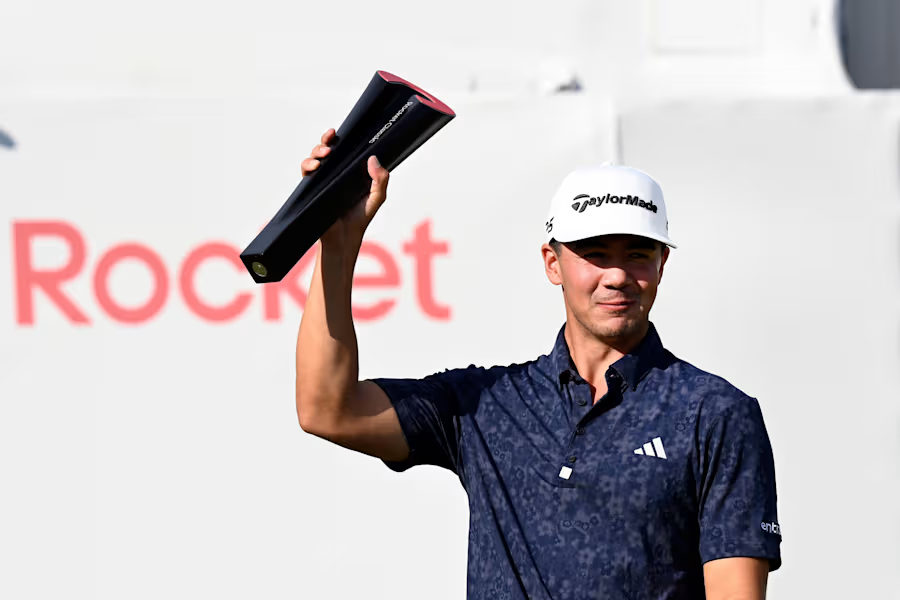
After eight years and a $10 million purse, the 2026 Rocket Classic closed its Detroit chapter with a first-time winner, a weather-disrupted final round, and a sponsorship exit that raises real questions about how PGA Tour events survive when sponsor, venue, and Tour stop aligning.
Michael Thorbjornsen's first PGA Tour victory came with an asterisk: it was also the last. The 2026 Rocket Classic, held July 30 through August 2 at Detroit Golf Club, marked the end of Rocket's title sponsorship after eight years. The event featured a $10 million purse, a weather-disrupted final round, and no successor deal in sight. With U.S. golf participation running about 4% ahead of 2025's pace, losing a well-funded Tour stop raises uncomfortable questions about the sport's calendar when sponsors, venues, and the Tour can't agree on a shared future.
A First Win on the Final Stage
Thorbjornsen earned his breakthrough on a par-70, 7,328-yard layout that analysts had previously described as driver-heavy and birdie-friendly. However, the 2026 edition played differently. Course changes and firmer greens emphasized accuracy and longer approach shots over raw distance. The 145-player field faced a setup that rewarded precision.
Then the weather intervened. Final-round storms forced the Tour to abandon standard pairings for three-player groupings and adjusted tee times. Coverage across Golf Channel, CBS, and PGA TOUR LIVE on ESPN+ captured the disruption in real time. Thorbjornsen managed both the course and the chaos, demonstrating composure and ball-striking under pressure—qualities worth more than any single leaderboard position.
Still, the lingering story isn't the winner; it's the exit.
Why Rocket Walked Away
Rocket did not extend its sponsorship beyond 2026. Local reports frame the split as a failure of alignment among the sponsor, Detroit Golf Club, and the PGA Tour. Detroit officials and tournament leadership have indicated that while the door isn't closed on a return, there are no active conversations for an immediate continuation. This suggests the calendar slot is now open and unclaimed.
The broader context is crucial. The U.S. golf market isn't shrinking. In 2025, approximately 48.1 million Americans participated in golf, with 29.1 million playing on-course and 37.9 million engaging off-course. More than 500 million rounds were played nationally for the sixth consecutive year. The golf equipment market is projected to grow from $22.45 billion in 2026 to $36.10 billion by 2035. The audience and money are present; what failed in Detroit was the specific arrangement, not the demand.
Industry analysts emphasize that 2026's real story is less about Thorbjornsen's win and more about Rocket's exit and its implications for PGA Tour sponsorship dynamics. Title sponsorship of a Tour event is costly, and the return on investment hinges on hospitality access, brand visibility, and civic identity. When any leg of that stool weakens, the deal unravels. Detroit's situation illustrates how quickly alignment can erode, even when the sport's macro numbers appear strong.
The Golf Boom Isn't Uniform
Calling this a crisis would overstate things, but asserting that U.S. golf is uniformly healthy would overlook important nuances. While American rounds trend upward, Great Britain saw a 14.5% decline in rounds year over year in Q1 2026. The growth narrative varies by location.
Off-course participation is a significant part of the American picture. The golf simulator market alone is projected to reach $2.11 billion in 2026, growing at a 10.1% rate through 2034. Nearly 3,000 municipal courses at over 2,600 facilities were operating at the start of 2026, the highest totals on record. Women's on-course participation climbed 46% since 2019, with over 8 million women and girls playing on-course in 2025. The sport's base is broader and more diverse than a decade ago. Whether this translates into sustainable Tour-event sponsorship remains uncertain.
What Comes Next for the Calendar Slot
The optimistic view is that "end" might signify a branding change rather than a market collapse. Detroit Golf Club remains a viable venue. The field attracted meaningful betting and media attention despite sponsor uncertainty. A new title partner could emerge, or the Tour could reconfigure the slot entirely.
The luxury golf travel market offers a parallel lesson. Trips increasingly sell as lifestyle experiences centered around food, culture, wellness, and exclusivity rather than just tee times. The focus is shifting toward intangible value: access, privacy, authenticity. Tour events seeking to attract premium sponsors and hospitality buyers must adopt a similar approach. A $10 million purse and network television aren't sufficient if the tournament experience doesn't meet brand expectations.
Thorbjornsen's name will permanently sit in the record books as the final Rocket Classic champion. He earned that. However, the tournament's legacy raises questions about infrastructure: who pays, who hosts, and whether the sport's governing bodies can maintain the local relationships necessary for a 40-plus-event season. Detroit proved that demand alone doesn't guarantee continuity; alignment does. And alignment, it turns out, is the harder shot to hit.